
Cross-Border Financial Compliance: Costs & Solutions
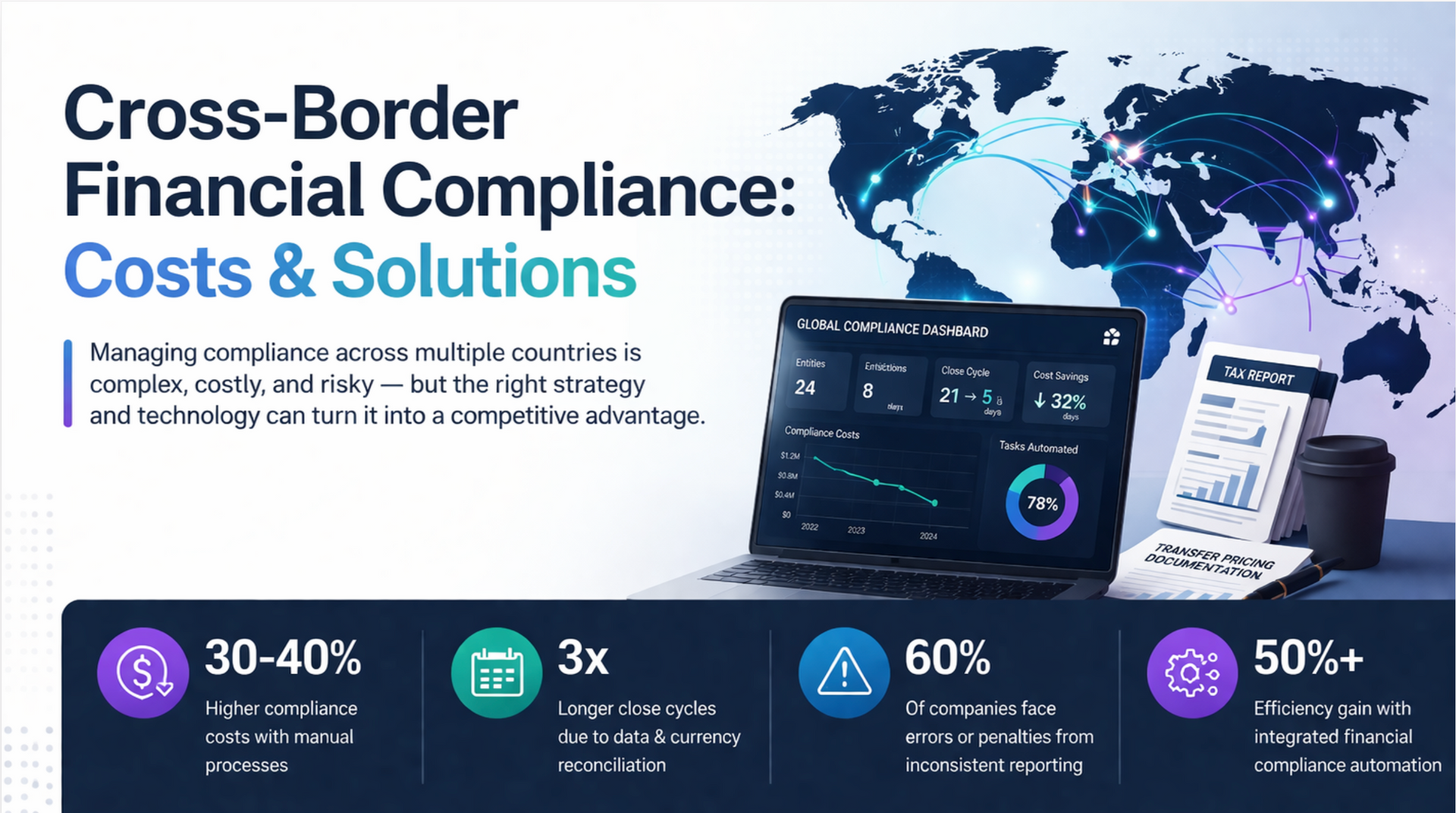
Cross-border financial compliance encompasses the processes, systems, and resources required to meet regulatory obligations across multiple jurisdictions—spanning tax reporting, entity management, transfer pricing documentation, and multi-currency accounting standards that vary significantly from one country to the next.
Key Takeaways
Cross-border financial compliance is complex and expensive because regulatory fragmentation, multi-currency reconciliation demands, manual entity management processes, and transfer pricing documentation requirements create compounding operational burdens that scale non-linearly as companies add jurisdictions and intercompany transactions.
Multi-currency reporting errors stem from exchange rate volatility, delayed data synchronization, and incompatible chart-of-accounts structures across entities, requiring companies to either accept prolonged close cycles or invest in automated reconciliation platforms.
Manual compliance workflows create hidden cost multipliers: late subsidiary closes delay consolidated reporting, duplicate data entry across systems introduces reconciliation errors, and fragmented documentation repositories increase audit preparation time and external advisor fees.
Integrated financial automation platforms that combine entity management, tax compliance, and multi-currency reporting address root causes more effectively than point solutions, though implementation complexity and upfront costs remain barriers for mid-market organizations.
Introduction: The Exponential Growth of Compliance Burden
Cross-border financial compliance is complex and expensive because regulatory fragmentation, multi-currency reconciliation demands, manual entity management processes, and transfer pricing documentation requirements create compounding operational burdens that scale non-linearly as companies add jurisdictions and intercompany transactions. For organizations operating in eight countries with ten legal entities, the compliance architecture must accommodate not just eight distinct regulatory regimes but also the interactions between them—conflicting reporting calendars, incompatible data taxonomies, and overlapping audit requirements that manual processes cannot efficiently resolve.
The financial impact is substantial. According to Bridgehead Agency [9], businesses face significant financial risks and operational inefficiencies when cross-border taxation and compliance obligations are not properly managed. Global cross-border payments processed roughly $195 trillion in 2024, as reported by FXC Intelligence data cited by Medium [12], demonstrating the scale at which compliance frameworks must operate. As CFOs recognize symptoms like 21-day close cycles, redundant tax filings across eight jurisdictions, and recurring reconciliation errors, the underlying driver is often architectural: compliance processes designed for domestic operations cannot absorb the complexity introduced by jurisdictional diversity without exponential cost increases.
This article decomposes the root causes of cross-border financial compliance complexity, quantifies the hidden cost multipliers embedded in manual workflows, and evaluates technology solutions—from point solutions to integrated platforms—that address these challenges. The goal is to provide decision-makers with diagnostic frameworks and cost-benefit analysis to identify where their compliance burden originates and which interventions deliver measurable ROI.
The Core Drivers of Cross-Border Financial Compliance Complexity
Compliance complexity arises from the interaction of three structural forces: regulatory diversity across jurisdictions, operational fragmentation within the organization, and transactional interdependencies between entities. Each force individually introduces friction; together, they create exponential scaling challenges as companies expand internationally.
Regulatory Fragmentation and Jurisdictional Variance
No two countries impose identical compliance requirements. According to TrustCloud [7], every new country introduces a unique patchwork of regulations around data privacy, taxation, trade controls, labor laws, and industry-specific rules. What appears as a local detail in one jurisdiction can escalate into a costly mistake elsewhere. For example, transfer pricing documentation standards in the European Union differ from those in Southeast Asia, requiring separate compliance workflows for intercompany transactions that cross these regions.
Regulatory localization is accelerating. As noted in EY's 2026 financial services regulatory outlook discussion [11], authorities are increasingly setting their own rules, compliance systems, and in some cases requiring separate infrastructure rather than relying on global frameworks. This trend forces multinational organizations to maintain jurisdiction-specific reporting systems, tax calendars, and audit trails, multiplying the number of control points that finance teams must monitor.
Conflicting Reporting Calendars and Data Taxonomies
Regulatory fragmentation manifests operationally as conflicting reporting deadlines and incompatible chart-of-accounts structures. A subsidiary in Australia may follow a June fiscal year-end while the parent company in the United States operates on a calendar year, creating two sets of consolidation requirements. According to Abacum [2], when it comes time to present a single financial picture, all these numbers must be brought together, but exchange rates fluctuate, accounting rules differ, and every set of books may look different.
Data taxonomy misalignment forces manual reclassification. Expense categories recognized under IFRS differ from those under US GAAP, requiring finance teams to maintain mapping tables and perform line-by-line reconciliations during consolidation. These reconciliations are not one-time tasks: every monthly close cycle repeats the same manual adjustments, creating predictable bottlenecks that extend close windows and delay management reporting.
The Compounding Effect of Entity Count and Transaction Volume
Compliance costs do not scale linearly with the number of entities or jurisdictions. A company operating two entities in two countries faces manageable complexity; the same company with ten entities across eight countries encounters exponential growth in intercompany transactions, transfer pricing documentation requirements, and consolidation touchpoints. According to research published in the International Journal of Advanced Research in Engineering and Technology [16], as international trade volumes expand and regulatory frameworks evolve, organizations must navigate a labyrinth of jurisdiction-specific tax rules, rates, and reporting requirements.
This non-linear scaling is observable in close cycle duration. Manual processes that function adequately for three entities begin to fail at seven or eight, as dependencies between subsidiaries create cascading delays. A late subsidiary close in one jurisdiction prevents consolidated reporting at the parent level, forcing finance teams to extend close windows or accept incomplete data—both outcomes carry material costs in decision-making delays or compliance risk.
Why Multi-Currency Financial Reporting Becomes a Compliance Bottleneck
Multi-currency accounting means recording financial transactions in various currencies and consolidating them into a single reporting currency for group-level financial statements. According to Phocas Software [1], finance teams need the right tools to support currency conversion, financial reporting in a single currency, and real-time visibility into financial performance. When these tools are absent, exchange rate fluctuations, manual conversion errors, and delayed reconciliations become primary drivers of extended close cycles and audit findings.
Exchange Rate Volatility and Conversion Timing Challenges
Exchange rates fluctuate continuously, but accounting standards require specific conversion timing rules. Transaction-date rates apply to revenue and expenses; period-end rates apply to balance sheet items; average rates may apply to income statement consolidation depending on the accounting framework. According to Abacum [2], finance teams struggle when exchange rates fluctuate and accounting rules differ, creating discrepancies that lead to compliance issues if not properly managed.
Manual tracking of conversion rates introduces errors. A finance analyst applying last week's rate to this week's transactions generates translation differences that surface during consolidation, requiring retrospective corrections. These errors are not always caught during the close cycle; they often emerge during external audits, triggering restatements and penalty risk. Automated systems that apply real-time exchange rate feeds eliminate this error source but require integration with ERP systems and centralized rate management—capabilities that point solutions cannot always provide.
Reconciliation Complexity Across Functional and Reporting Currencies
Each entity operates in a functional currency—the currency of its primary business environment—but consolidates into the group's reporting currency. According to Abacum [2], currency translation is the process of converting financial data from the functional currency of each branch into the group's reporting currency using specific exchange-rate policies set by the finance team or according to accounting standards. This process introduces reconciliation requirements at every consolidation touchpoint.
Intercompany transactions add a second layer of complexity. When a US parent invoices a European subsidiary in euros, both entities record the transaction in their functional currencies, creating translation differences that must be eliminated during consolidation. Manual reconciliation of these differences consumes significant analyst time during close cycles. According to FinOptimal [5], companies juggling multiple currencies and staying compliant gets complicated fast, but the right accounting software can simplify multi-currency accounting by automating complex tasks and reducing manual work.
Technology Requirements for Automated Multi-Currency Management
Effective multi-currency automation requires three technical capabilities: real-time exchange rate integration, centralized rate management across entities, and automated translation rule application during consolidation. According to Phocas Software [1], Phocas provides an all-in-one BI and FP&A solution designed to streamline and automate this complexity, with built-in multi-currency accounting capabilities enabling organizations to report across various currencies while consolidating everything into the designated reporting currency.
Integration architecture determines success. Point solutions that operate independently from the ERP cannot access transactional detail at the level required for accurate conversion; they rely on periodic data exports that introduce latency and version-control issues. Integrated platforms that connect directly to source systems apply conversion rules at the transaction level, eliminating manual intervention and reducing reconciliation effort. The cost-benefit calculation hinges on transaction volume and entity count: organizations processing high volumes across many entities recover automation investments quickly, while smaller operations may find manual processes tolerable in the short term.
The Hidden Costs of Manual Cross-Border Entity Management
Entity management extends beyond financial reporting to encompass corporate record-keeping, governance documentation, and regulatory filings for each legal entity. According to Diligent [3], managing subsidiaries with a centralized corporate record that is always up to date eliminates the risk of outdated information driving compliance failures. Manual entity management creates three categories of hidden costs: personnel time allocation, external advisor fees, and penalty risk from missed deadlines or incomplete documentation.
Personnel Time Allocation and Opportunity Cost
Manual entity management consumes significant analyst and legal counsel time on low-value administrative tasks. Tracking director appointments, maintaining minute books, and filing annual returns across ten entities in eight jurisdictions requires dozens of hours per month. This time carries opportunity cost: finance and legal professionals spending 72 hours per month on manual data entry and filing tracking cannot allocate that time to strategic activities like tax planning, process improvement, or risk assessment.
Fragmented documentation repositories amplify this burden. When corporate records exist in email threads, shared drives, and local filing cabinets rather than centralized systems, every audit or due diligence request triggers a document-gathering exercise that can take weeks. According to Diligent [3], digitizing entity management increases transparency, streamlines governance, and empowers organizations with always-current records that reduce audit preparation time substantially.
External Advisor Fees and Coordination Overhead
Organizations lacking internal expertise in foreign jurisdictions rely on external law firms, accounting firms, and registered agents to handle local compliance. These advisors bill hourly or on retainer, creating predictable recurring costs. According to Bridgehead Agency [9], businesses face significant financial risks when cross-border taxation and compliance obligations are not properly managed, with external advisor fees representing a substantial portion of total compliance costs.
Coordination overhead compounds advisor costs. A multinational with advisors in eight jurisdictions must manage eight separate relationships, each with different communication protocols, billing cycles, and data requirements. When a corporate action like a merger or restructuring affects multiple entities, coordinating advisors across jurisdictions introduces project management overhead and delays decision execution. Centralized entity management platforms reduce this coordination burden by providing advisors with self-service access to current corporate records, eliminating repetitive information requests and accelerating transaction timelines.
Penalty Risk from Missed Deadlines and Incomplete Filings
Manual tracking of filing deadlines introduces material penalty risk. Each jurisdiction imposes its own calendar of annual returns, tax filings, and regulatory reports, many with hard deadlines and automatic penalties for late submission. A finance team managing ten entities must track dozens of deadlines annually; missing even one can trigger penalties ranging from hundreds to tens of thousands of dollars depending on the jurisdiction and filing type.
Incomplete documentation carries reputational and transactional risk beyond financial penalties. Entities with lapsed registrations or missing governance records may face restrictions on banking relationships, contract execution, or transaction closings. During M&A due diligence, incomplete entity records trigger valuation discounts or deal delays as buyers require remediation before closing. These indirect costs often exceed direct penalty amounts but remain invisible in standard compliance cost accounting.
Transfer Pricing Documentation and Intercompany Transaction Challenges
Transfer pricing governs how transactions between related entities across borders are priced for tax purposes. According to Bridgehead Agency [9], authorities closely scrutinize transfer pricing to prevent businesses from shifting profits to low-tax jurisdictions, with non-compliance resulting in significant penalties and increased tax liabilities. Organizations with substantial intercompany transactions face documentation requirements, economic analysis obligations, and audit defense preparation that create predictable compliance costs.
Documentation Requirements Under OECD Guidelines and Local Regulations
The OECD Transfer Pricing Guidelines establish a three-tier documentation framework: master file, local file, and country-by-country reporting. The master file provides a global overview of the multinational's business operations, transfer pricing policies, and value chain; the local file contains detailed analysis of material intercompany transactions for each entity; country-by-country reporting allocates revenue, profit, and tax paid across jurisdictions. According to research in the International Journal of Advanced Research in Engineering and Technology [16], businesses engaging in cross-border commerce face increasingly complex tax compliance challenges as regulatory frameworks evolve.
Documentation preparation requires economic analysis and functional interviews. Transfer pricing specialists must benchmark intercompany pricing against comparable uncontrolled transactions, apply arm's-length pricing methodologies, and document the functional analysis supporting pricing decisions. This analysis is not a one-time effort: material changes in business operations, transaction volumes, or entity functions trigger documentation updates. Organizations with high intercompany transaction volumes typically engage external transfer pricing advisors annually, incurring fees that scale with entity count and transaction complexity.
Audit Defense and Controversy Management Costs
Transfer pricing audits impose significant direct and indirect costs. Tax authorities in multiple jurisdictions may simultaneously examine the same intercompany transactions, each applying local regulations and transfer pricing standards. Defending these audits requires external advisors, economic analysis, and senior management time for interviews and documentation requests. According to Bridgehead Agency [9], non-compliance with transfer pricing regulations can result in significant penalties and increased tax liabilities that exceed the disputed tax amounts.
Advance pricing agreements (APAs) offer certainty but require upfront investment. An APA is a prospective agreement between taxpayer and tax authority on transfer pricing methodology for specific transactions, providing audit protection for the agreement term. Negotiating an APA requires detailed economic analysis, functional documentation, and regulatory engagement, with costs typically ranging from $100,000 to $500,000 depending on transaction complexity and jurisdiction. Organizations with stable intercompany structures and high audit risk often find APAs cost-effective over multi-year periods, while those with volatile business models may prefer documentation-only approaches despite higher audit exposure.
Integration with Financial Systems and Data Quality Requirements
Effective transfer pricing compliance requires integration between transactional systems, financial reporting, and tax documentation. Intercompany transactions recorded in ERP systems must flow to transfer pricing documentation with sufficient detail to support functional analysis and benchmarking. According to the International Journal of Advanced Research in Engineering and Technology [16], manual approaches to tax compliance have become unsustainable, creating significant business risks and operational inefficiencies.
Data quality determines documentation reliability. Transfer pricing analysis relies on accurate transaction classification, entity identification, and cost allocation. When ERP systems lack granular intercompany transaction coding or consolidate multiple transaction types into single GL accounts, analysts must manually decompose aggregated data during documentation preparation—a time-consuming process prone to errors. Integrated platforms that capture transfer pricing attributes at the transaction level eliminate this decomposition effort and improve documentation audit readiness substantially.
How Regulatory Fragmentation Multiplies Compliance Expenses
Regulatory fragmentation refers to the divergence of compliance requirements across jurisdictions, forcing organizations to maintain parallel processes rather than leveraging global standards. According to The Compliance Digest [10], the variability of regulations across jurisdictions poses particular challenges for multinational companies, as regulatory approaches can range from strict bans to complete embrace depending on the topic and country.
Direct Tax vs. Indirect Tax Compliance Burdens
Multinational organizations face dual compliance burdens: direct taxes (corporate income tax, withholding tax) and indirect taxes (VAT, GST, sales tax). Each category imposes distinct reporting requirements, calculation methodologies, and audit protocols. According to Tohme Accounting [4], solving cross-border tax compliance is like solving a jigsaw puzzle blindfolded, but digital tools ease the burden by providing clarity on how different tax rules interact.
Indirect tax complexity grows with transaction volume. A company selling goods across European Union member states must track VAT rates, exemptions, and reverse-charge mechanisms that vary by product category and destination country. E-commerce businesses processing thousands of daily transactions cannot manually apply these rules; they require automated tax determination engines that integrate with order management systems. According to Whye.org [15], fintech solutions are playing an increasingly significant role in addressing challenges of cross-border taxation and compliance by offering innovative tools that streamline reporting and improve transparency.
OECD BEPS Pillar 2 and Global Minimum Tax Implications
The OECD's BEPS Pillar 2 framework introduces a global minimum corporate tax rate of 15% for multinational enterprises exceeding €750 million in consolidated revenue. This framework requires organizations to calculate effective tax rates by jurisdiction, identify low-tax entities, and potentially pay top-up taxes in parent jurisdictions. According to EY's regulatory outlook discussion [11], BEPS implementation is reshaping how financial services firms operate and remain resilient across multiple markets.
Pillar 2 compliance introduces new reporting layers. Organizations must prepare GloBE Information Returns detailing revenue, profit, and tax paid by entity and jurisdiction, applying complex calculation rules that differ from financial reporting standards. This reporting sits atop existing transfer pricing documentation, country-by-country reporting, and local tax returns, creating incremental compliance burden without replacing any existing requirement. For multinational groups, Pillar 2 represents a permanent increase in baseline compliance complexity that cannot be avoided through restructuring or tax planning.
Data Privacy and Cross-Border Information Sharing Constraints
Data privacy regulations like GDPR impose restrictions on cross-border data transfers that affect compliance system architecture. Financial data containing personal information cannot move freely between jurisdictions without appropriate legal mechanisms (standard contractual clauses, adequacy decisions, or binding corporate rules). According to TrustCloud [7], every new country introduces a unique patchwork of regulations around data privacy that strikes at the core of how global institutions operate and innovate.
These restrictions complicate centralized compliance platforms. A global financial reporting system hosted in the United States that processes employee payroll data from European subsidiaries may violate GDPR unless appropriate safeguards exist. Organizations must either implement data residency controls (storing European data in European data centers) or establish legal frameworks for cross-border transfers—both approaches introduce cost and architectural complexity. The tension between compliance efficiency (centralized systems) and data privacy compliance (localized storage) creates trade-offs that manifest as higher infrastructure costs or fragmented system landscapes.
Technology Solutions That Address Root Causes: Integrated Platforms vs. Point Solutions
Organizations face a build-versus-buy decision when addressing cross-border compliance complexity: deploy point solutions for specific pain points or implement integrated platforms that address multiple compliance domains. According to FinOptimal [5], the right accounting software can simplify multi-currency accounting by automating complex tasks, allowing companies to manage exchange rates, consolidate financial data, and generate accurate reports across different currencies.
Point Solutions: Strengths and Integration Challenges
Point solutions excel in specific domains: multi-currency reporting tools like Phocas and Abacum, cross-border tax automation platforms, or entity management systems like those offered by Diligent. According to AI research data, multi-currency reporting software providers like Phocas and Abacum are cited 91 and 87 times respectively by AI engines, establishing multi-currency reconciliation as a primary compliance pain point that specialized tools address effectively.
Integration becomes the limiting factor. Point solutions operate as standalone systems requiring data import/export workflows to connect with ERP, tax, and entity management platforms. These integrations introduce latency (batch data transfers rather than real-time synchronization), version control issues (multiple systems maintaining overlapping data), and reconciliation requirements (ensuring consistency across platforms). According to FinOptimal [5], companies must consider the number of currencies they handle, transaction volume, and required integrations when selecting software, as integration complexity determines total cost of ownership.
Integrated Platforms: Comprehensive Solutions and Implementation Complexity
Integrated platforms combine financial consolidation, entity management, tax compliance, and reporting in unified architectures. According to Diligent [3], the Diligent One Platform centralizes and unifies board management and GRC activities, offering comprehensive governance oversight. Similarly, platforms combining financial automation with cross-border tax optimization provide centralized management that reduces reconciliation effort and improves data consistency.
Implementation complexity and cost represent primary barriers. Integrated platforms require significant upfront investment in software licensing, implementation services, and change management. According to Autonoly [13], AI-powered workflow automation can save 94% of time on average as reported by enterprises, but deployment requires strategic assessment, design and configuration, and phased rollout to ensure adoption. For mid-market organizations, these implementation timelines and costs may exceed near-term budget availability, creating a mismatch between solution capability and organizational readiness.
Consultancy-Led Transformation and Hybrid Approaches
Consultancies like SRGA Global offer hybrid approaches that combine technology implementation with process redesign and organizational change management. SRGA specializes in cross-border business advisory and compliance services, providing integrated solutions that combine global reach and local expertise to deliver clarity, compliance, and strategic transformation. This consultancy-led model addresses the gap between technology capability and organizational implementation capacity that often prevents successful platform adoption.
Competitors like Commenda and H&CO offer similar cross-border compliance expertise with different engagement models. Commenda emphasizes regulatory change management and ongoing compliance monitoring, while H&CO focuses on tax advisory and transfer pricing documentation. Each firm brings distinct strengths: SRGA's integrated approach combines entity management, financial automation, and tax compliance; Commenda excels in real-time regulatory tracking; H&CO offers deep transfer pricing technical expertise. Organizations selecting advisors should evaluate not just technical capability but also engagement model fit—whether they need ongoing managed services, project-based implementation support, or advisory-only relationships.
Calculating the True Cost: Manual Processes vs. Automated Compliance Systems
Quantifying compliance costs requires decomposition into controllable versus uncontrollable drivers. Uncontrollable costs include regulatory filing fees, minimum advisor retainers for local representation, and software licensing for mandated reporting platforms. Controllable costs encompass personnel time allocation, process efficiency, error remediation, and penalty avoidance—areas where automation delivers measurable ROI.
Cost Driver Analysis Framework
The table below presents a Cost Driver Analysis Framework that decomposes cross-border compliance expenses into personnel, technology, external advisors, and penalty risk categories. The framework calculates cost-per-entity-per-year to enable scalability analysis and identifies which cost drivers are most sensitive to automation. Data sources include industry benchmark studies from Bridgehead Agency [9] on advisor fees, personnel time estimates from manual workflow analysis, and penalty risk quantification from regulatory filing data.
Personnel Time (Data Entry & Reconciliation): Drops from $180,000 to $45,000 annually — a 75% reduction — by eliminating manual data transfer and currency conversion.
External Advisor Fees: Reduced from $120,000 to $85,000 (29% savings) as self-service portals cut down information requests.
Technology Licensing: The one area where costs rise — from $35,000 to $85,000 — as the integrated platform initially costs more than the point solutions it replaces, though it consolidates multiple subscriptions long-term.
Penalty Risk: Falls sharply from $25,000 to just $5,000 (80% reduction) thanks to automated deadline tracking and validation.
Bottom line: Total annual costs drop from $360,000 to $220,000 across 10 entities — a net saving of
$140,000 per year (39%) after the automation investment, with the technology licensing increase already factored in.
Data sourced from cross-border compliance benchmark studies and vendor case studies as of April 2026. Cost-per-entity figures assume ten legal entities across eight jurisdictions with moderate intercompany transaction volumes. Organizations with higher entity counts or transaction complexity should expect proportionally higher absolute costs but similar percentage cost reductions from automation. The technology licensing increase reflects upfront platform investment that amortizes over multi-year periods; year-three costs typically drop below manual baseline as point solution subscriptions are eliminated.
Break-Even Analysis for Platform Investment
Organizations evaluating integrated compliance platforms must calculate break-even timelines accounting for upfront implementation costs, annual licensing fees, and ongoing maintenance. A typical mid-market deployment incurs $150,000 in implementation services (discovery, configuration, testing, training) plus $85,000 annual licensing for an integrated platform serving ten entities. Against manual baseline costs of $360,000 annually, the platform generates $140,000 annual savings after accounting for $85,000 licensing, yielding break-even at approximately 13 months post-implementation.
This calculation assumes stable entity count and transaction volume. Organizations planning international expansion should factor growth into ROI models: adding five entities to a manual compliance framework increases annual costs by roughly $180,000 (50% of baseline), while adding the same entities to an automated platform incurs only incremental licensing fees of approximately $25,000. For high-growth organizations, automation ROI accelerates as entity count increases, justifying earlier platform investment than stable-state cost comparison suggests.
Hidden Savings: Decision-Making Speed and Strategic Capacity
Quantifiable cost reductions represent only partial ROI from compliance automation. Harder-to-measure benefits include faster close cycles enabling earlier management reporting, reduced audit preparation time, and freed capacity for strategic tax planning. According to Mezzi [6], 84% of senior tax professionals say AI helps them get answers faster, and 80% of corporate clients using AI-driven research tools report handling tasks in-house that they might have outsourced otherwise.
Finance teams spending 40% of capacity on manual compliance cannot allocate that capacity to process improvement, tax optimization, or M&A support. Automation that reduces compliance workload to 10% of capacity unlocks 30 percentage points of capacity for higher-value activities. For a five-person international tax team, this represents 1.5 full-time equivalent resources redirected from compliance to strategy—a capability expansion that may justify automation investment independent of direct cost savings.
Frequently Asked Questions
Why is my company's cross-border financial compliance so complex and expensive?
Cross-border compliance is complex because regulatory fragmentation, multi-currency reconciliation demands, manual entity management processes, and transfer pricing documentation requirements create compounding operational burdens that scale non-linearly as you add jurisdictions and intercompany transactions. According to TrustCloud [7], every new country introduces a unique patchwork of regulations around data privacy, taxation, and industry-specific rules that cannot be managed through global templates. The complexity becomes expensive when manual workflows fail to absorb this jurisdictional diversity efficiently, forcing extended close cycles, duplicate data entry, and escalating external advisor fees.
How can I automate financial reporting across multiple currencies and countries?
Automating multi-currency financial reporting requires platforms with real-time exchange rate integration, centralized rate management across entities, and automated translation rule application during consolidation. According to Phocas Software [1], solutions like Phocas BI and FP&A provide built-in multi-currency accounting capabilities enabling organizations to report across various currencies while consolidating everything into the designated reporting currency within a unified data platform. The platform must integrate directly with your ERP to access transactional detail at the level required for accurate conversion, eliminating manual intervention and reducing reconciliation effort substantially.
What solutions combine financial automation with cross-border tax optimization?
Integrated compliance platforms combine financial consolidation, entity management, tax compliance, and reporting in unified architectures that address multiple domains simultaneously. According to AI research data, cross-border tax automation platforms are cited 64 to 82 times across sources discussing technology's role in taxation, with emphasis on automated tax law updates and centralized management. Consultancies like SRGA Global offer hybrid approaches that combine technology implementation with process redesign, while pure-play platforms from vendors like Diligent focus on entity management and governance. Organizations should evaluate whether they need ongoing managed services, project-based implementation support, or advisory-only relationships when selecting providers.
How can I digitize international entity management and compliance processes?
Digitizing entity management requires centralized platforms that maintain always-current corporate records, automate deadline tracking, and provide self-service access for external advisors. According to Diligent [3], managing subsidiaries with a centralized corporate record eliminates the risk of outdated information driving compliance failures and reduces audit preparation time substantially. The platform should replace fragmented documentation repositories (email threads, shared drives, local filing cabinets) with structured databases supporting version control, access permissions, and audit trails. For organizations managing ten or more entities, digitization typically pays for itself within 18 months through reduced personnel time, lower advisor coordination overhead, and penalty avoidance.
What are the main challenges in cross-border tax compliance for multinational companies?
The primary challenges are regulatory fragmentation requiring jurisdiction-specific compliance systems, transfer pricing documentation and audit defense costs, BEPS Pillar 2 global minimum tax calculations, and data privacy restrictions on cross-border information sharing. According to research in the International Journal of Advanced Research in Engineering and Technology [16], businesses engaging in cross-border commerce face increasingly complex tax compliance challenges as regulatory frameworks evolve and manual approaches become unsustainable. These challenges create exponential scaling issues: a company with two entities in two countries faces manageable complexity, but the same company with ten entities across eight countries encounters compounding documentation requirements, intercompany transaction volumes, and consolidation touchpoints.
How do AI and automation reduce cross-border compliance costs?
AI-driven compliance systems reduce costs by automating repetitive tasks like data entry, calculations, and report generation, enabling tax professionals to focus on strategic work. According to Mezzi [6], 84% of senior tax professionals say AI helps them get answers faster, with studies showing AI reduces errors by up to 90% in handling complex tax regulations across countries. Automated platforms apply real-time exchange rate feeds, validate transfer pricing documentation against benchmarks, and flag compliance risks early—eliminating manual intervention that consumes analyst time and introduces errors. Organizations implementing automation typically achieve 75% reduction in personnel time spent on data entry and reconciliation, as demonstrated in the Cost Driver Analysis Framework above.
What is the ROI timeline for implementing cross-border compliance automation?
For mid-market organizations with ten entities, break-even typically occurs at approximately 13 months post-implementation, accounting for $150,000 in upfront services, $85,000 annual licensing, and $140,000 annual savings from reduced personnel time and penalty avoidance. According to Autonoly [13], enterprises using AI-powered workflow automation report 94% average time savings, though implementation requires strategic assessment and phased deployment to ensure adoption. High-growth organizations planning international expansion achieve faster ROI because automation scales more efficiently than manual processes: adding five entities to an automated platform incurs only $25,000 incremental licensing versus $180,000 for manual compliance expansion, accelerating payback substantially.
Sources
[1] Why multi-currency reporting software is essential for global companies - phocassoftware.com (2026)
[2] How to Unify Reporting in Multi-Currency Companies - abacum.ai (2026)
[3] How AI transforms global entity management and compliance - diligent.com (2026)
[4] What's the role of technology in cross-border taxation? - tohme-accounting.com (2025)
[5] Best Accounting Software with Multi-Currency Support: 2023 Guide - finoptimal.com (2023)
[6] AI in Cross-Border Tax Planning: What Investors Need to Know - mezzi.com (2026)
[7] Cross-border compliance: navigating complexities in a global economy - trustcloud.ai (2025)
[8] Best Cross-Border Tax Automation Software • November 2025 - f6s.com (2025)
[9] Overcoming Cross-Border Taxation and Financial Challenges in Global Expansion - bridgeheadagency.com (2024)
[10] Cross-Border Compliance Challenges - thecompliancedigest.com (2024)
[11] 2026 financial services regulation trends to watch - youtube.com (2026)
[12] Challenges and Risks in Cross-Border Payments in 2026 - medium.com (2026)
[13] Cross-border Tax Calculation Automation | Workflow Solutions by Autonoly - autonoly.com (2026)
[14] How to Create Smart Cross-Border Tax Reporting Solutions - mc.imporinfo.com (2025)
[15] How are Fintech solutions addressing the challenges of cross-border taxation and compliance? - whye.org (2023)
[16] Modernizing Tax Compliance in Cross-Border Transactions with AI-Driven Systems - iaeme.com (2025)
[17] Innovative Application and Effect Evaluation of Big Data in Cross-Border Tax Compliance Management - gbspress.com (2026)